When Money Stops Being Money: Gaza’s Cash Crisis and the Political Economy of Scarcity
1 Independent Consultant (Economic Development & Political Economy), Gaza, Palestine
Corresponding author: Bashar M. Skaik — bashar@economicadvisoryhub.com
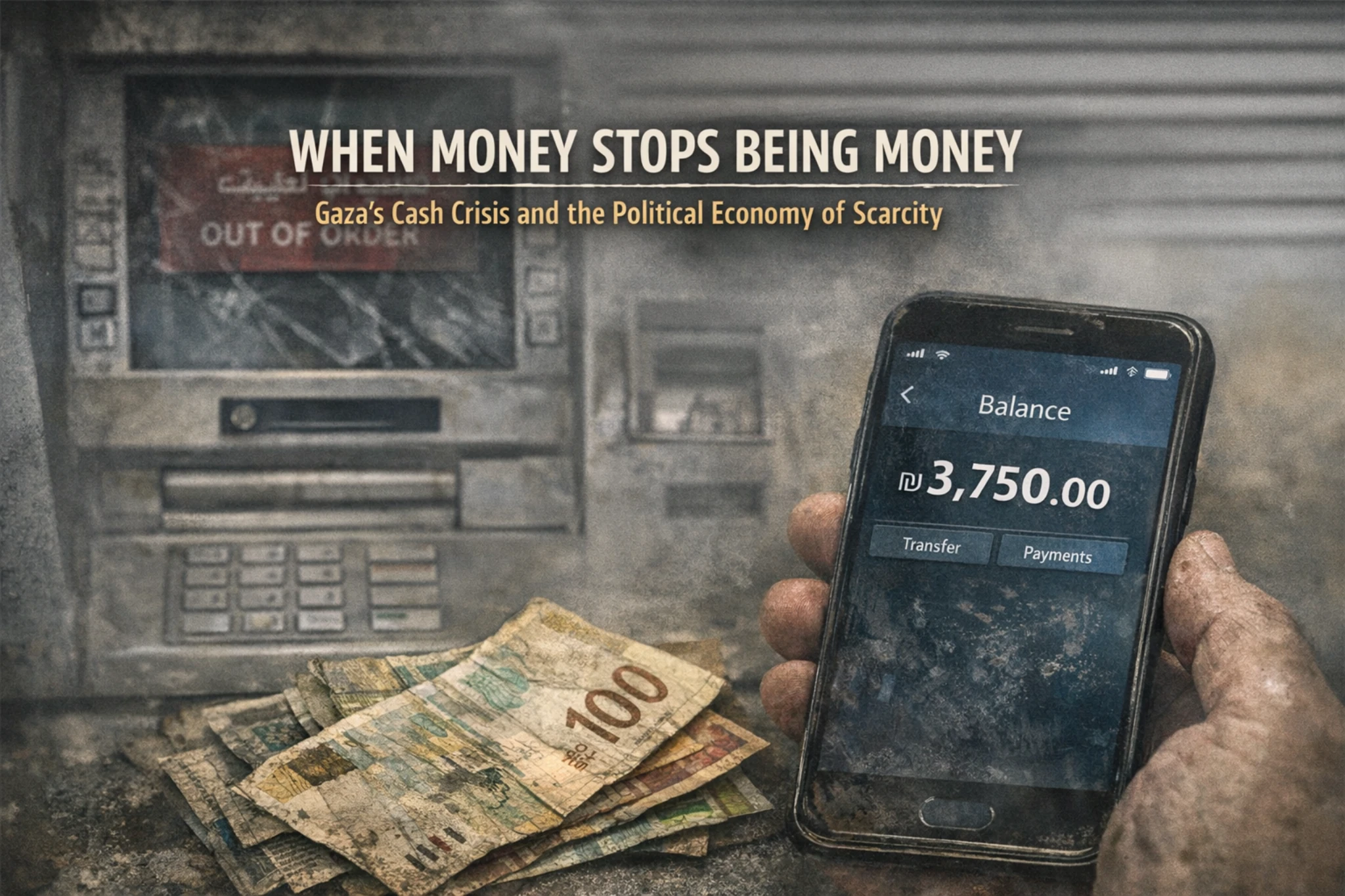
In Gaza, the wartime crisis was not simply a shortage of cash or a conventional banking failure. It was a breakdown in the circulation and convertibility of physical money that turned access to cash into a commodity, allowing scarcity, brokerage, and coercion to reshape everyday economic life.
War does not destroy economies only by wrecking homes, roads, firms, and institutions. It also destroys the invisible mechanisms through which money becomes usable in daily life. Gaza offers a severe illustration of this truth. Salaries could still be credited. Aid could still be transferred. Balances could still appear on screens. Yet none of these was equivalent to liquidity in the practical sense if cash could not be withdrawn, if digital payments were not widely accepted, if notes in circulation were damaged or refused, and if converting one’s own balance into banknotes meant losing a quarter, a third, or sometimes more. The crisis, then, was not merely that money grew scarce. It was that money stopped being uniform. A shekel in the hand became worth more than a shekel on a ledger, and the distance between the two became a market of desperation.
To describe this simply as a banking crisis is misleading. The central problem was not, at least in origin, a classic insolvency event in which balances vanished from the books. Nor was it merely an accidental shortage of notes. What Gaza experienced was more layered and more damaging: the severing of cash supply channels, the paralysis of withdrawal infrastructure, the deterioration of note quality, the fragmentation of security, and the rise of intermediaries who transformed access to cash into a lucrative business. In such a setting, the question is no longer whether money exists in accounting form. The question is whether it can still perform its transactional function in daily life.
Key figures
- Before the war: Gaza reportedly had 56 bank branches and 91 ATMs.
- By May 2024: only five branches and seven ATMs remained operational.
- End of 2024: total cash liquidity in Gaza across currencies reportedly stood at only USD 25.6 million.
- NIS cash liquidity: fell from USD 271.0 million in 2023 to USD 18.5 million in 2024.
- By February 2025: Gaza reportedly had more than 530,000 e-wallet users with balances exceeding USD 40 million.
- Cash-out fees: still ranged around 17–20% in some periods and reportedly reached up to 40% in others.
The empirical indicators are stark. Before the war, Gaza reportedly had 56 bank branches and 91 ATMs. By May 2024, Reuters reported that only five branches and seven ATMs remained operational. By the end of 2024, the Palestine Monetary Authority reported that total cash liquidity in Gaza across currencies stood at only USD 25.6 million, while NIS cash liquidity had fallen from USD 271.0 million in 2023 to USD 18.5 million in 2024. Yet digital balances did not disappear. On the contrary, they expanded. By February 2025, Gaza reportedly had more than 530,000 e-wallet users with balances exceeding USD 40 million. But those balances did not solve the crisis, because the convertibility problem remained. In late 2025 and early 2026, reported cash-out fees still ranged from roughly 17–20 percent and, in some cases, up to 40 percent. The numbers reveal the essence of the problem: money survived in nominal form while usable money collapsed.
A Crisis of Convertibility, Not Only of Cash
This is why the concept of convertibility matters more than the simpler language of shortage. Under normal conditions, a unit of money held in a bank account is treated as functionally equivalent to a unit held in cash because conversion between the two is cheap, quick, and routine. In wartime Gaza, that equivalence broke down. A worker paid electronically might receive only a fraction of the nominal balance in physical notes after paying a broker or cash trader. In effect, the economy began quoting two prices for the same shekel: one for money on screen, and another for money in hand. The spread between them was the price of liquidity. What appeared as a commission was, in reality, a forced discount imposed by scarcity, fragmentation, and power.
This spread did not arise in a vacuum. First came the interruption of supply. Reuters reported in May 2024 that Israel had blocked cash imports into Gaza since the start of the war, striking at the foundation of liquidity in an economy heavily dependent on the shekel and unable to issue its own sovereign currency. Then came the collapse of distribution. Branches and ATMs were destroyed, shut, or rendered inaccessible by physical damage, insecurity, electricity shortages, and communications failures. The Palestine Monetary Authority itself warned in April 2024 that repeated attacks on bank branches and ATMs, along with power and telecom failures, were obstructing access to financial services. Finally came predation. Armed gangs reportedly charged for priority access to ATMs, while major bank robberies were also reported. Cash ceased to be a neutral medium of exchange and became instead an object of seizure, brokerage, and contest.
A further distortion deepened the crisis: not all cash remained equally usable. Worn notes, torn notes, and certain denominations were increasingly refused in trade. This meant that the crisis was not only about the volume of cash in circulation, but also about the quality of that cash. A damaged note that exists physically but is no longer widely accepted is not fully liquid. This degraded the stock of effective money even further and helped produce a monetary hierarchy. At the top stood usable physical cash in acceptable denominations and condition. Below it stood damaged or selectively refused cash. Below that stood bank balances and e-wallet balances usable only where digital acceptance existed. And below even those stood digital claims that could be turned into spendable life only through punishing discounts. Gaza did not cease to use money. It fractured money into ranks.
Analytical conclusion
- The crisis was not simply a shortage of money.
- It was a collapse of convertibility between nominal money and usable money.
- Once convertibility broke down, cash acquired a premium.
- That premium became the basis for scarcity rents, regressive transfers, and coercive intermediation.
How Scarcity Became a Rent System
Once money splits into ranks, rents emerge. That is the political economy at the heart of the crisis. Physical cash became a scarce asset whose holders could extract returns above ordinary commercial margins. Cash brokers, money changers, cash-out agents, merchants with liquid inventories, and other intermediaries came to occupy a valuable bottleneck between digital balances and physical notes. What looked like service provision was often something much harsher: a transfer of value from those trapped in inferior forms of money to those controlling the superior form. A salary paid digitally but cashed out at a 30 percent discount is not merely delayed income. It is income partially appropriated by those who control access to liquidity. The same applies to aid recipients and small traders. Gaza’s liquidity crisis therefore became not only a monetary disruption, but also a mechanism of regressive redistribution.
This is why the crisis cannot be understood as equal suffering under equal shortage. The burdens were distributed asymmetrically. Salaried workers whose incomes continued through formal channels often discovered that nominal wages were no longer equal to real purchasing power. Aid recipients benefited on net from digital transfers, but not at full value if part of that value leaked into commissions before it could be spent. Poorer households, older people, displaced families, and those with weak digital access suffered further disadvantages because they were more dependent on intermediaries, devices they did not have, networks that did not work reliably, or formal procedures they could not navigate. Small traders faced a parallel ordeal: they needed cash for change-making, inputs, transport, and petty exchange, yet found themselves in an economy where even money itself had become uncertain, stratified, and discriminatory. The poor, in short, did not merely endure scarcity; they paid for it.
Who lost value?
- Salaried workers: nominal wages often translated into reduced real purchasing power at cash-out.
- Aid recipients: transfers helped, but commissions could erode part of their welfare value.
- Poor and digitally excluded households: were more dependent on intermediaries, devices, charging, and connectivity they often lacked.
- Small traders: needed cash for change-making, transport, stock replenishment, and daily petty exchange.
The sharpest analytical mistake would be to force the crisis into a false binary: either it was a wholly objective shortage, or it was entirely fabricated. The stronger conclusion is more exacting. The crisis was structural in origin but partially manufactured in operation. War, blockade, infrastructure destruction, monetary dependence, and the interruption of cash inflows created a genuine collapse of circulation. But that structural collapse did not remain a neutral technical event. It became organized, priced, exploited, and monetized. Actors with cash, brokerage position, coercive leverage, or privileged access could deepen the pain of shortage and privatize its gains. That is why it is more accurate to say that the shortage was real while its severity, persistence, and distributive effects were amplified by predation, arbitrage, and selective control over conversion.
This distinction matters especially when discussing armed or politically connected actors. The evidence supports a serious but bounded conclusion: wartime collapse in governance and security opened space for extortion, robbery, coercive brokerage, and the occupation of key access points in the circulation chain. Available reporting suggests that armed networks, including actors reportedly linked to or claiming affiliation with Hamas, were among those who may have benefited from, influenced, or amplified the crisis. But the argument does not need overstatement. The more credible position is the more precise one: the structural shock was real, and the resulting regime of scarcity became a field of profit and power for those able to dominate the bottleneck.
Who Paid the Price
The costs of the liquidity crisis were not distributed evenly. Salaried workers whose incomes continued through formal channels often discovered that nominal wages were no longer equal to real purchasing power because they had to pay commissions to obtain usable cash. Aid recipients still benefited on net from digital transfers, but not at full value if part of the transfer leaked into commissions before it could be spent. Poorer households, older people, displaced families, and those with weak digital access were pushed into even greater dependence on intermediaries and unreliable networks. Small traders faced a similar burden because they needed cash for change-making, petty purchases, transport, and daily commercial exchange.
In short, the crisis did not merely create generalized hardship. It redistributed hardship unevenly. Those with access to cash could preserve or enlarge their position. Those dependent on digital claims had to surrender value simply to render their own money usable. This is why the crisis must be understood not as equal suffering under neutral shortage, but as stratified suffering under a monetized regime of access. Beyond consumption itself, the crisis also eroded dignity and autonomy. To lose a portion of one’s wage or aid transfer merely to obtain cash was not only an economic injury. It was a loss of control over the very terms of survival.
Bottom line
- The crisis redistributed hardship unevenly.
- Those with cash or access to it gained leverage.
- Those dependent on digital balances lost value before they could even spend it.
- The result was not just monetary dysfunction, but a socially corrosive regime of dependence.
What Recovery Requires
The policy implication follows directly from the diagnosis. Gaza’s recovery cannot rest on digitization alone. Digital rails mattered enormously. They preserved some continuity of payment and reduced what would otherwise have been an even deeper collapse. But no amount of digitization can abolish the premium on cash if daily life still requires notes, if merchant acceptance remains partial, if electricity and telecommunications are fragile, if households lack devices or charging capacity, and if the stock of usable cash is not replenished. Gaza’s recovery therefore requires a dual-track approach: controlled restoration of physical cash, especially usable small denominations, alongside stronger digital infrastructure, wider merchant acceptance, compression of cash-out commissions, protection of remaining financial infrastructure, note-quality management, and better monitoring of liquidity conditions.
The objective is not simply technical normalization. It is to restore monetary function as a civilian entitlement rather than leave it as a privilege sold at a premium. A society already devastated by war should not be forced to pay a liquidity tax merely to use its own money.
Conclusion
The liquidity crisis in Gaza during and after the war was not, in the strict sense, a disappearance of money. Deposits remained on ledgers. Salaries continued, in many cases, to be credited electronically. Humanitarian transfers increasingly moved through digital channels. What collapsed was something more concrete and more decisive: the circulation, accessibility, and convertibility of physical cash. In that collapse, the ordinary equivalence between money in an account and money in the hand broke down.
This crisis was both real and exploitative. It was real because Gaza’s monetary architecture was already fragile and was then shattered by war, blocked cash inflows, damaged infrastructure, insecurity, and note deterioration. But it was also exploitative because the breakdown became an arena of profit, coercion, and unequal access. The poor did not merely suffer scarcity. They subsidized those who controlled liquidity.
That is why Gaza’s cash crisis must be understood not merely as a technical malfunction, but as a political economy of scarcity.
Full paper (PDF)
This web edition is adapted for Kawkab Gaza. The complete original paper can be viewed here:
References
- Tobin, James. “The Interest-Elasticity of Transactions Demand for Cash.” Review of Economics and Statistics 38, no. 3 (1956): 241–247. https://fraser.stlouisfed.org/title/1171/item/3313
- Nosal, Ed, and Guillaume Rocheteau. Money, Payments, and Liquidity. Cambridge, MA: MIT Press, 2011. https://academic.oup.com/mit-press-scholarship-online/book/23882
- Keynes, John Maynard. The General Theory of Employment, Interest, and Money. London: Macmillan, 1936. https://www.files.ethz.ch/isn/125515/1366_keynestheoryofemployment.pdf
- Espinoza, Raphael A., and Dimitrios P. Tsomocos. “Monetary Transaction Costs and the Term Premium.” IMF Working Paper 13/85, April 2013. https://www.imf.org/external/pubs/ft/wp/2013/wp1385.pdf
- Collier, Paul. Doing Well out of War. Washington, DC: World Bank, April 10, 1999. https://documents1.worldbank.org/curated/en/504671468762020790/pdf/28137.pdf
- Brunnermeier, Markus K., and Lasse Heje Pedersen. “Market Liquidity and Funding Liquidity.” The Review of Financial Studies 22, no. 6 (2009): 2201–2238. https://doi.org/10.1093/rfs/hhn098
- Bianchi, Javier, and Saki Bigio. “Portfolio Choice and Settlement Frictions: A Theory of Endogenous Convenience Yields.” NBER Working Paper 34474, November 2025. https://doi.org/10.3386/w34474
- Baumol, William J. “The Transactions Demand for Cash: An Inventory Theoretic Approach.” The Quarterly Journal of Economics 66, no. 4 (1952): 545–556. https://doi.org/10.2307/1882104
- Le Monde. “Gaza’s Banks Targeted by Armed Groups.” May 5, 2024. https://www.lemonde.fr/en/international/article/2024/05/05/gaza-s-banks-targeted-by-armed-groups_6670475_4.html
- Nassar, Ohood. “The Cash Liquidity Crisis in Gaza.” Institute for Palestine Studies, March 10, 2026. https://www.palestine-studies.org/en/node/1658738
- Government of Norway. “Launch of the Emergency Coalition for the Financial Sustainability of the Palestinian Authority.” September 26, 2025. https://www.regjeringen.no/en/whats-new/launch-of-the-emergency-coalition-for-the-financial-sustainability-of-the-palestinian-authority/id3120283/
- OCHA. “Gaza Humanitarian Response | Situation Report No. 60.” January 9, 2026. https://www.ochaopt.org/content/gaza-humanitarian-response-situation-report-no-60
- OCHA. “Gaza Humanitarian Response Update | 10–23 June 2024.” June 26, 2024. https://www.ochaopt.org/content/gaza-humanitarian-response-update-10-23-june-2024
- OCHA. “Humanitarian Situation Report | 6 March 2026.” March 6, 2026. https://www.ochaopt.org/content/humanitarian-situation-report-6-march-2026
- Palestine Monetary Authority. Financial Stability Report 2024. 2025. https://www.pma.ps/Portals/0/Users/002/02/2/Publications/English/Annual%20Reports/Financial%20Stability%20Reports/Financial%20Stability%20Report%202024.pdf
- Palestine Monetary Authority. “Questions and Answers from the PMA Regarding the ILS Accumulation Crisis.” June 19, 2025. https://www.pma.ps/en/Media/Press-Releases/questions-and-answers-from-the-pma-regarding-the-ils-accumulation-crisis
- Palestine Monetary Authority. “The PMA Announces Alternatives for Dealing with Cash Liquidity after the Destruction of Bank Branches in the Gaza Strip.” May 8, 2024. https://www.pma.ps/en/Media/Press-Releases/the-pma-announces-alternatives-for-dealing-with-cash-liquidity-after-the-destruction-of-bank-branches-in-the-gaza-strip
- Palestine Monetary Authority. “The PMA: Repeated Attacks on Bank Branches in the Gaza Strip Exacerbate Citizens’ Suffering.” April 22, 2024. https://www.pma.ps/en/Media/Press-Releases/the-pma-repeated-attacks-on-bank-branches-in-the-gaza-strip-exacerbate-citizens-suffering
- Reuters. “As the Guns Fall Silent, Gazans Find Newly-Reopened Banks Have No Cash.” October 31, 2025. https://www.reuters.com/world/middle-east/guns-fall-silent-gazans-find-newly-reopened-banks-have-no-cash-2025-10-31/
- Reuters. “Criminal Gangs, Profiteers Thrive in Gaza as Cash Shortage Worsens Misery.” May 14, 2024. https://www.reuters.com/world/middle-east/criminal-gangs-profiteers-thrive-gaza-cash-shortage-worsens-misery-2024-05-14/
- World Bank. Note on the Impacts of the Conflict in the Middle East on the Palestinian Economy – April 2025. Washington, DC: World Bank, 2025. https://thedocs.worldbank.org/en/doc/0f21311c2ebb0df4bf9b493a8034997c-0280012025/original/82687546-6fc3-46fa-80ba-5ce29d2148bc.pdf